In scenarios such as government stockpiling, post-disaster resettlement, and NGO aid distribution, bulk procurement of emergency relief sleeping bags is never a simple matter of comparing a few quotes. The choice of supply source directly affects delivery reliability, quality consistency, regulatory document completeness, and ultimately whether the entire project passes inspection and acceptance.
For most large-volume projects, Chinese suppliers typically achieve a balance across quality compliance, reasonable total cost, and controllable delivery timelines — owing to their complete industrial chain, mature large-scale production capacity, accumulated lightweight manufacturing expertise, and well-developed export trade services. This is the core rationale for prioritizing China as a primary sourcing destination. This article examines the global supply landscape, core procurement advantages, risk management considerations, and typical applicable project types, to help B2B procurement teams systematically evaluate the feasibility of China-sourced emergency relief sleeping bags in real-world projects.
I. Global Supply Landscape for Emergency Relief Sleeping Bags: How Do Three Sourcing Tiers Work?
The international procurement sources for emergency relief sleeping bags typically fall into three tiers.
Domestic or local production offers the fastest response with the shortest transport distance, making it suitable for the first wave of material distribution in the immediate aftermath of a disaster. However, local production capacity is limited, making rapid scale-up to tens of thousands of units difficult, and per-unit costs tend to be substantially higher.
Regional manufacturing centers balance response speed with cost control and are suited for material allocation within regional cooperative mechanisms. However, in specialized capabilities such as customizing multiple fill-weight tiers or managing packaging consistency for compressed storage formats, regional suppliers vary considerably in performance.
Global manufacturing centers led by China excel in medium-to-large bulk procurement: complete supply chain coverage, flexible customization, and mature export processes make China especially well-suited to handle long-term resettlement replenishment and national-level stockpile batch orders.
A "local emergency response + China mid-to-long-term replenishment" combined strategy is widely adopted by government and NGO projects. The core value of Chinese suppliers is concentrated in the sustained resettlement phase and stockpile replenishment cycle, rather than the 72-hour extreme-urgency response window.
II. What Core Capabilities Has China Built in the Emergency Relief Sleeping Bag Sector?
China is both a country frequently affected by natural disasters and a significant supplier of materials for international humanitarian assistance. Through years of real-world project fulfillment, Chinese factories producing relief-specific sleeping bags have developed systematic operational capabilities spanning the full chain from raw material control to full-container export — covering standardized fill-weight quality control, volume consistency management for compressed storage packaging, rapid switching between multilingual package labeling, and systematic preparation of complete export documentation sets.
For NGO or cross-national government project teams, working with a capable Chinese emergency relief sleeping bag supplier can significantly reduce the risks of customs clearance delays and acceptance failures caused by inconsistent product specifications or incomplete shipping documents.
III. What Are the Core Advantages of Sourcing Emergency Relief Sleeping Bags from China?
Complete Industrial Chain — From Fabric and Fill to Full-Container Export, All in One Location
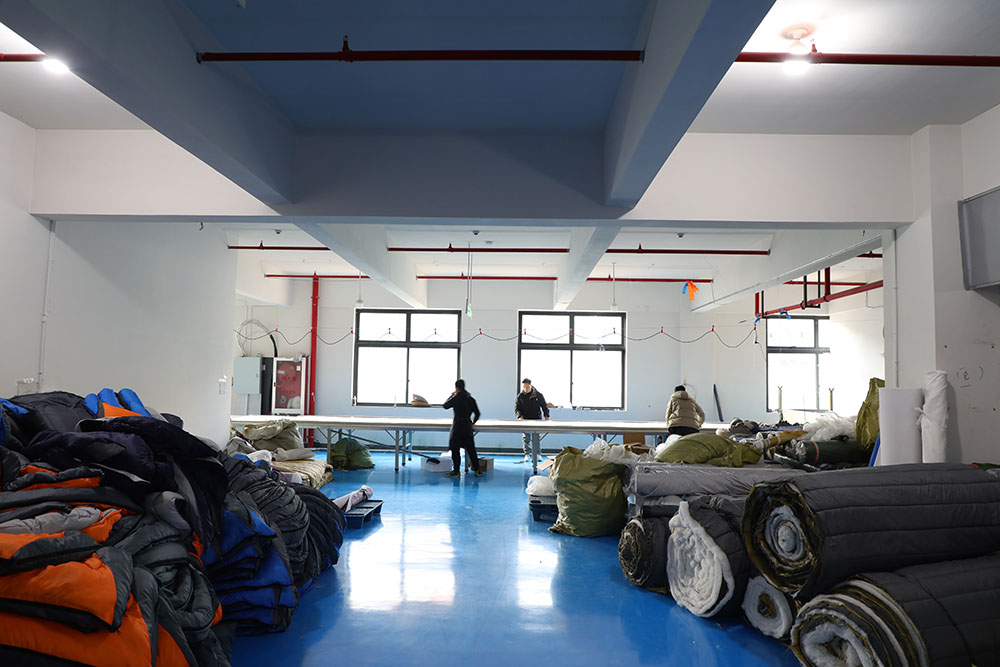
The upstream of the emergency sleeping bag supply chain encompasses stable supply of shell fabrics (high-density polyester, waterproof Oxford cloth), fill materials (hollow-fiber batting, synthetic down), zippers, and packaging materials. The midstream concentrates cutting, sewing, filling, and waterproof coating processes. The downstream integrates testing laboratories, export trade services, and container logistics nodes.
This highly clustered industrial ecosystem means that when a project needs to add waterproof emergency sleeping bags or temporarily adjust fill-weight specifications within a batch, coordination response times are far shorter than with dispersed supply sources. For national-level stockpile projects requiring multiple fill-weight tiers within a single batch, completing everything within one sourcing region in China is also far more operationally viable.
Large-Scale Production and Emergency Delivery — Sustained Supply for Bulk Orders, Contingency Plans for Rush Orders
Most mature relief sleeping bag factories can fulfill batch orders ranging from several thousand to over one hundred thousand units. Standard production lead times run approximately 2–4 weeks from specification confirmation, plus 25–35 days of ocean freight time, giving procurement teams a reliable framework for overall project scheduling (subject to contract terms).
During peak demand periods such as flood season or cold-front warnings, industry-wide demand can spike in a short window. It is advisable to communicate production capacity reservations with suppliers 3–6 months in advance, secure priority scheduling during peak seasons, and include phased delivery milestones and corresponding penalty clauses in the contract.
For a comprehensive breakdown of specification selection logic and key acceptance criteria for emergency relief sleeping bags, please refer to the article on this site: How to Choose High-Quality Emergency Relief Sleeping Bags | 2026 Professional Buying Guide, which covers the complete selection methodology from material standards to acceptance checklists.
Why Can't Emergency Relief Sleeping Bag Procurement Be Based on Unit Price Alone?
This is one of the most commonly underestimated factors in B2B procurement decision-making, and one of the primary drivers of total project cost overruns.
(1)Service Life and Replenishment Frequency Products with insufficient fill weight or low-density shell fabrics wear out more quickly under high-frequency use conditions at resettlement sites, shortening the replenishment cycle and ultimately increasing total expenditure. Sleeping bags incorporating three-dimensional anti-tear construction offer noticeably superior durability — a key element of bulk customization quality assurance and a critical dimension for evaluating overall cost-effectiveness.
(2)Compressed Volume and Freight Cost Compressed-storage-type relief sleeping bags with equivalent insulation performance can increase container packing density by 15–25% compared to unoptimized versions. Across large-volume cross-border shipments, this difference directly translates into quantifiable logistics cost savings — a variable that cannot be overlooked in overall budget management.
(3)Certification Compliance and Acceptance Pass Rates Prioritizing factories that hold OEKO-TEX certification and amfori BSCI certification helps reduce acceptance risks on government and NGO projects, and lowers the probability of full-batch returns caused by incomplete compliance documentation.
(4)Destination Country Customs Compliance Costs Tariff rates and certification requirements for imported textiles vary significantly by destination country. Some countries offer temporary duty-free channels for disaster relief goods, but these require complete supporting documents to be prepared in advance. It is advisable to investigate destination-country customs requirements at the inquiry stage, incorporating compliance costs into the overall budget estimate rather than addressing them reactively at the port of clearance.
Customization Capability and One-Stop Sourcing — Flexible Configuration by Project Needs
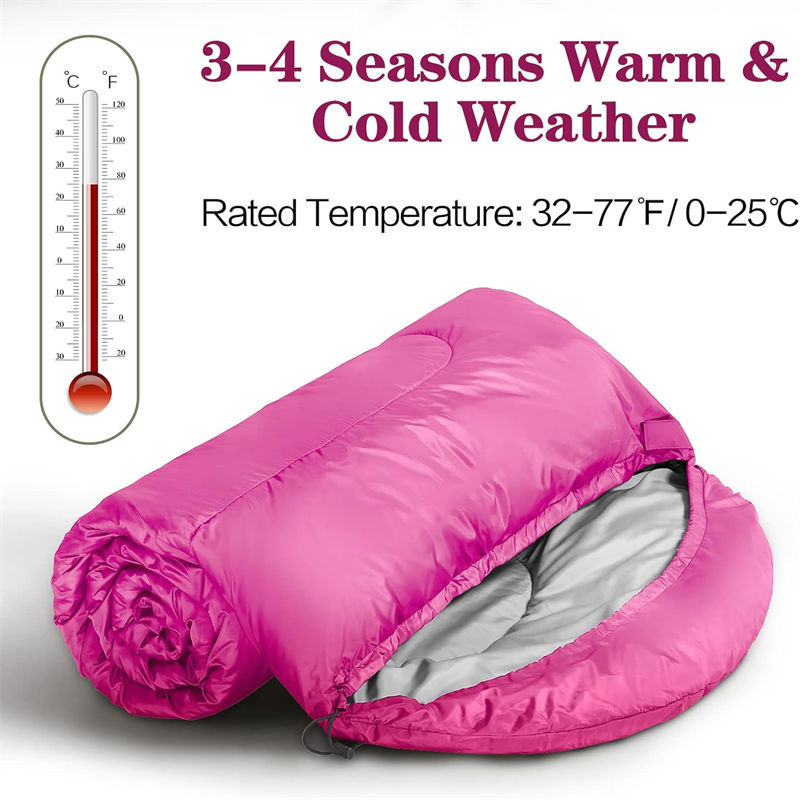
Chinese emergency relief sleeping bag manufacturers broadly offer OEM/ODM customization, allowing project-specific adjustments to fill weight, shell color (standardized colors aid batch management and distribution identification), zipper type, and multilingual packaging labels.
Many integrated suppliers can simultaneously provide complementary resettlement supplies, enabling one-stop emergency supplies procurement — for example, combining emergency blankets, moisture-proof pads, and emergency tents within a single order. This reduces the number of suppliers a procurement team must coordinate with, and consolidated container loading further lowers the logistics coordination costs and error rates associated with multiple separate shipments.
Mature Export Services — Complete Documentation and Full Customs Support
Chinese suppliers with international project experience typically support major trade terms including FOB, CIF, and EXW, and can assist in preparing commercial invoices, packing lists, certificates of origin, testing reports, and product description documents to meet the tendering document requirements of government procurement and international aid projects. Export teams generally have strong English communication capability, making them well-suited for cross-timezone project collaboration. FOB and CIF are the most commonly used terms in cross-border aid projects; EXW is better suited for situations where the buyer has a local logistics agent in China. It is advisable to clarify trade terms before contract finalization to avoid unclear delineation of logistics responsibility at a later stage.
IV. What Potential Risks Need to Be Proactively Managed When Sourcing from China?
Even when China is selected as the primary supply source, the following five categories of risk should be actively managed from the outset of the project:
Risk 1: Uneven Supplier Quality Tiers Request third-party testing reports for fill weight (verifying whether actual measured values match labeled values), batch-sampling records for zipper smoothness, and testing reports for waterproofing or flame-retardancy performance. Arrange an independent third-party factory audit to complete independent verification of key indicators before contract signing.
Risk 2: Specification Requirement Transmission Distortion Confirm material type, fill-weight tolerance (recommend specifying ±5% or ±10%), dimensional allowances, and color standards (Pantone or swatch references) in written specification sheets. Avoid relying solely on verbal descriptions, which can lead to bulk goods deviating from confirmed samples.
Risk 3: Peak-Season Production Resource Constraints If procurement is planned around flood season or cold-front warning periods, inform the supplier in advance and include phased delivery milestones and delay penalty clauses in the contract. Build in a 10–15 day buffer in the overall project timeline.
Risk 4: Destination Country Customs Compliance Risks At the project initiation stage, confirm import textile certification requirements and tariff policies with a local agent or resident office in the destination country. If necessary, include applicable certification requirements in the procurement specification to avoid additional detention or inspection fees at the destination port.
Risk 5: Incomplete Contract Terms Contracts should specify key technical indicator tolerances, arrival acceptance sampling ratios and pass/fail criteria, timeframes and responsibility allocation for handling nonconforming goods, and destination-country customs clearance responsibility — ensuring that any quality disputes can be traced and resolved according to documented terms.
V. Which Project Types Are Best Suited to Prioritizing Chinese Emergency Relief Sleeping Bag Suppliers?
The following project types are highly aligned with China's supply chain core advantages and should be treated as priority candidates for China-sourced procurement:
National/Regional Emergency Stockpile Projects: Requiring bulk procurement of relief sleeping bags, multi-tier specification combinations, long-term storage management, and periodic rotation replenishment;
Large-Scale Post-Disaster International Aid Projects: Requiring multiple categories of resettlement supplies to be assembled within a controllable timeframe, where one-stop supply capability is particularly critical;
NGO/International Organization Humanitarian Aid Projects: Requiring OEKO-TEX and similar international certifications, complete compliance documentation, and experience coordinating multi-destination distribution;
Government-Led Foreign Aid or Bilateral Assistance Projects: With high requirements for government procurement of emergency relief sleeping bags in terms of price competitiveness, large-batch delivery capability, and documentation completeness;
Export Distributors Operating Long-Term Regional Markets: Requiring stable production capacity, flexible customization capability, and consistent replenishment supply.
For 72-hour extreme-urgency distribution in the immediate aftermath of a disaster, local or regional supply remains the first choice. China-sourced supply is better suited to the "sustained resettlement phase" and "stockpile replenishment" cycle — which is also where the largest material volumes are needed across most projects.
VI. YRF Emergency Relief Supplies: A Representative One-Stop Chinese Emergency Relief Sleeping Bag Supplier
Among Chinese emergency relief sleeping bag suppliers, YRF Emergency Relief Supplies focuses on the research, development, and large-scale production of emergency relief materials. Its core product capabilities are oriented toward dual-performance delivery of thermal comfort and three-dimensional anti-tear durability, with integrated production line capability supporting bulk customization quality assurance and multi-scenario adaptability — making it suitable for a wide range of project scenarios from government stockpiling to international aid programs.
Certifications and Compliance: YRF holds OEKO-TEX certification (international safety standard for harmful substances in textiles) and amfori BSCI certification (supply chain social compliance standard). It can provide parameter sheets, testing reports, and product description documents to meet tendering requirements for government and NGO projects. If a project requires additional specific certifications, YRF can assist in coordinating with third-party certification bodies. Technical consulting services are available 24/7, with complete electronic product documentation available upon request.
Export and Logistics: YRF supports FOB, CIF, EXW, and other trade terms. The export team has English and multilingual project communication capability, with familiarity in the complete documentation systems required for international aid projects.
One-Stop Sourcing: In addition to emergency relief sleeping bags, YRF can simultaneously supply complementary resettlement items including emergency blankets, moisture-proof pads, and folding beds, making it suitable for government stockpile and international aid projects that need to complete multi-category procurement through a single supplier.
For a comparative overview of the qualifications and capabilities of leading Chinese suppliers, please refer to the article on this site: Top 10 China Emergency Relief Sleeping Bag Manufacturers | 2026 Authoritative Procurement Recommendations, which systematically reviews multiple Chinese factories across dimensions including production capacity, certifications, delivery performance, and export service capability.
حقوق النشر © Custom Disaster - Relief Bedding: Tents, Sleeping Bags, Blankets كل الحقوق محفوظة
الفريق المحترف للخدمة !