التصنيفات
Last Updated: October 15, 2026
Bulk relief procurement in Africa follows a repeating cycle: RFQ, samples, compliance checks, packing approval and delivery. Suppliers who miss one step lose the tender even with the lowest price. This checklist walks through what to prepare at each stage, what buyers verify, and the packing and delivery terms that prevent problems after the order is awarded.
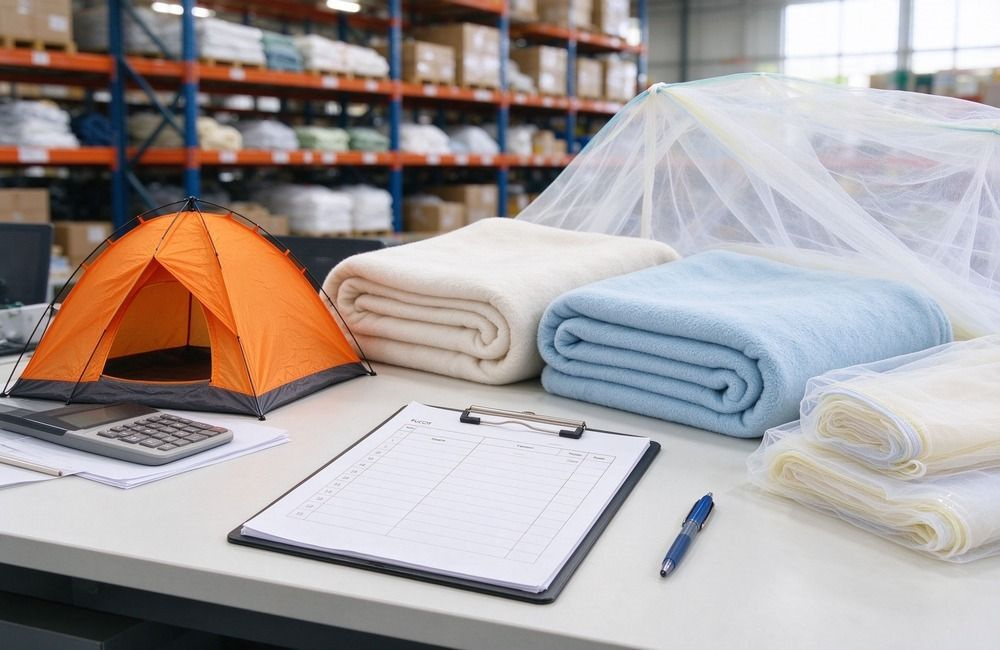
A relief procurement checklist with samples and warehouse stock.
The procurement checklist in the photo ties the whole order together: samples approved, specification confirmed, packing marked, delivery terms agreed. Every line on the checklist is a checkpoint for the buyer and the supplier, and a completed checklist is what allows the shipment to be released without a last-minute question.
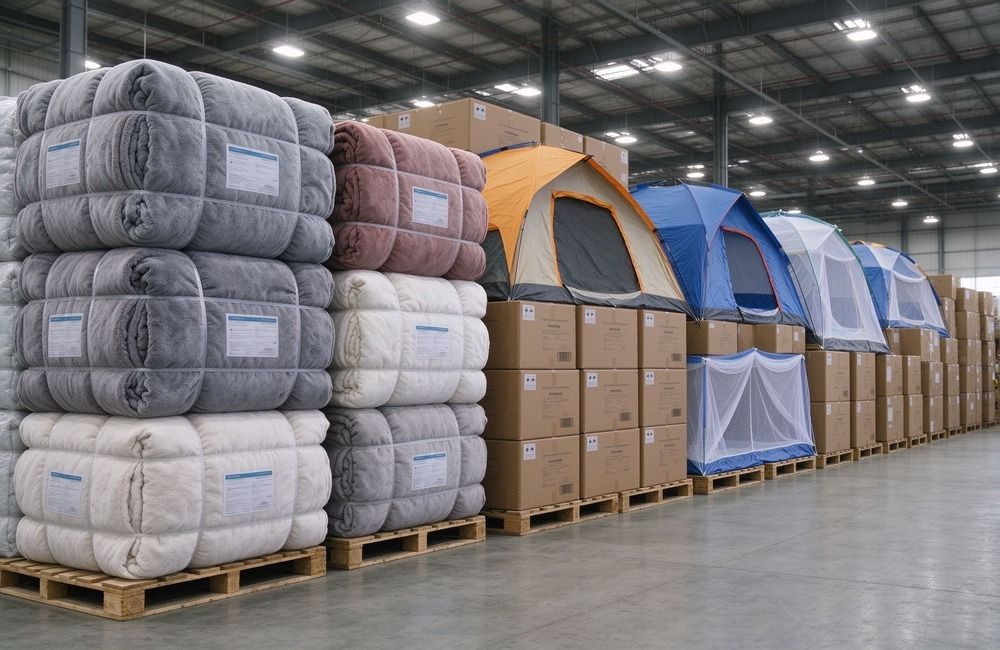
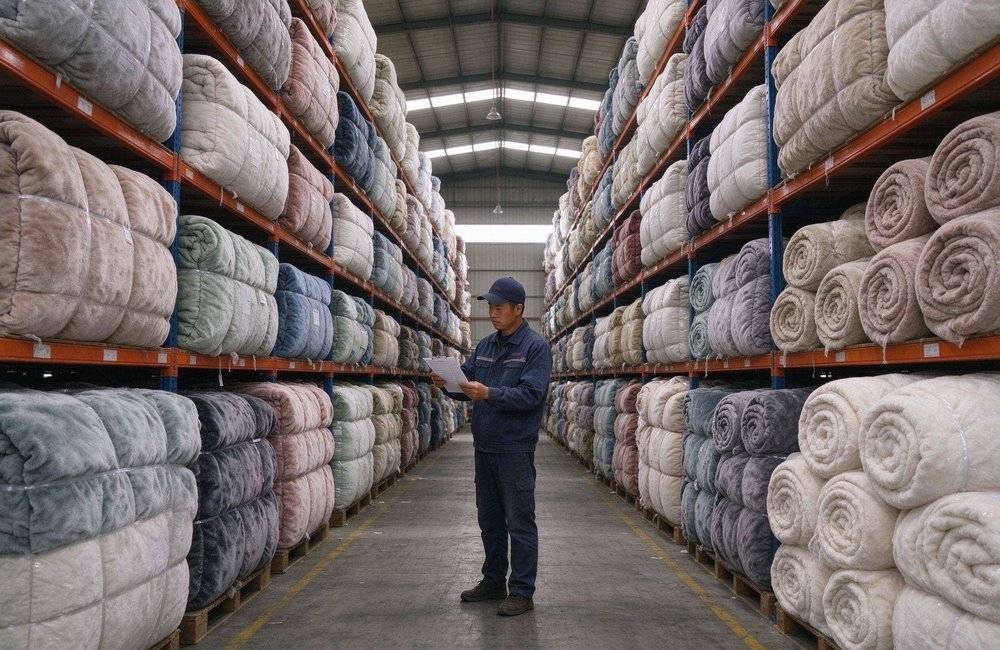
Relief goods stcked and ready in a bright warehouse.
Every bulk relief procurement program starts with the same question: what exactly are we buying, and does the specification match the hazard? Flood zones need quick-dry and mould-resistant blankets; highland drought zones need warmer weights; cyclone corridors need wind-resistant shelter. The right specification is not the cheapest option — it is the option that survives the field conditions the program will actually face, and that can be verified before production begins.

Procurement team reviewing blanket samples in the warehouse.
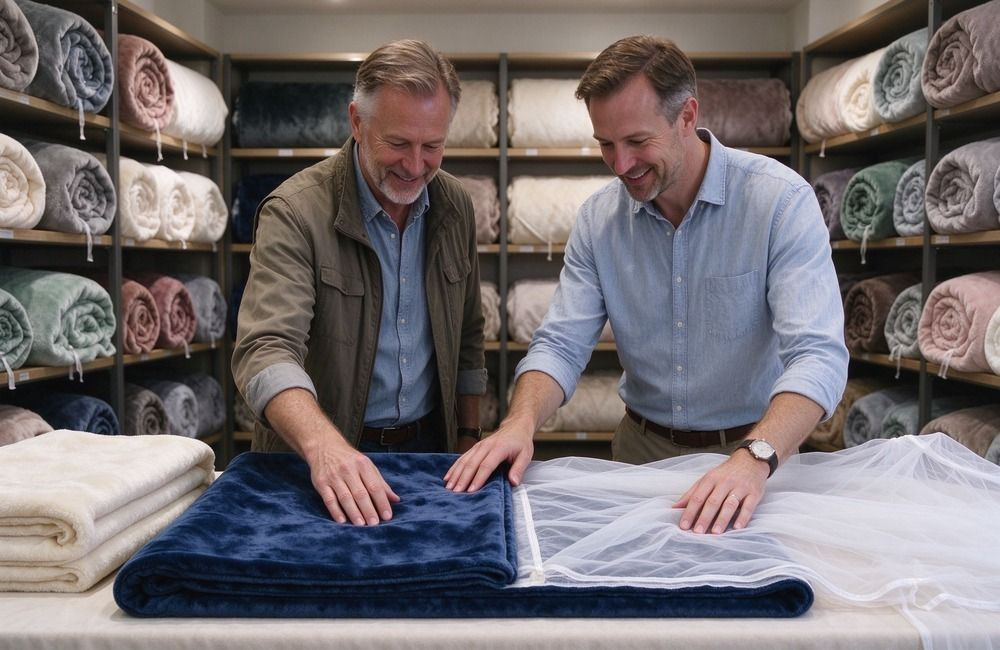
Samples are the checkpoint where a written specification becomes a physical product. A proper bulk relief procurement sample approval workflow covers fabric weight, stitching, colour fastness, packing density and label accuracy, and it gives both buyer and factory a signed reference that the bulk order must match. Skipping this step is the single most common cause of relief goods arriving on site with the wrong weight, size or packing.

A complete relief kit: blankets, tent, net and hygiene items.
Packing determines whether goods survive the journey. Compressed bales reduce ocean freight cost, carton labelling speeds customs clearance, and moisture protection prevents mould during weeks at sea. The packing plan should be agreed before production, not after, because it affects how many units fit per container, how long loading takes, and how easily field teams can distribute the goods once they arrive.
This guide brings the whole cycle together in one checklist: specification, samples, packing, lead times, quote comparison, documentation and final delivery. It is written for procurement officers, logistics coordinators and supply managers who need a repeatable process they can use across blankets, tents, nets and responder gear — with links to the deeper product guides for each category.
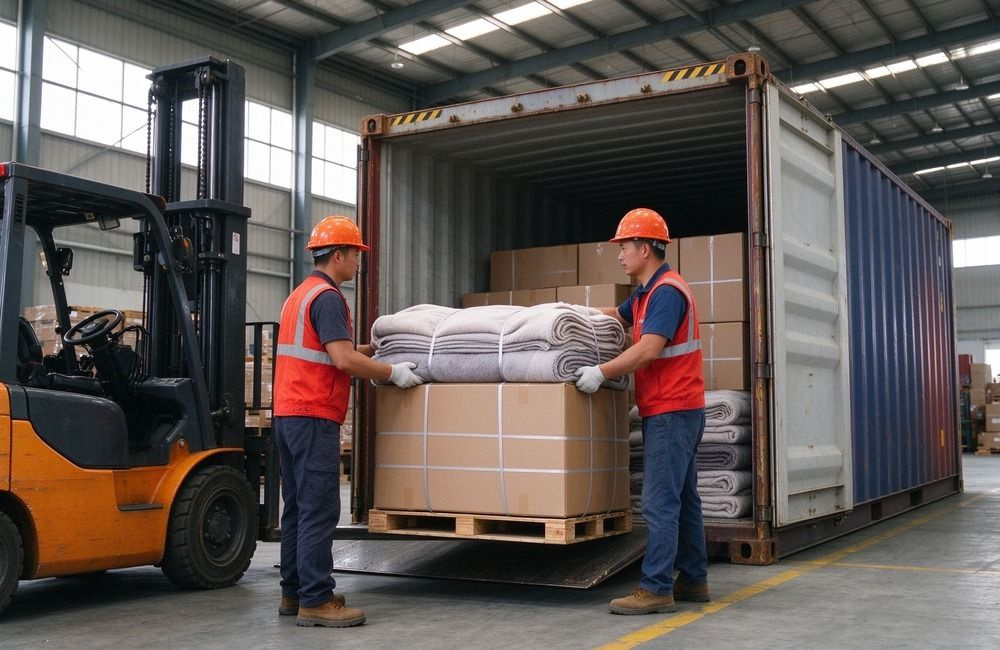
Loading relief supplies into a shipping container.
Table of Contents
wholesale emergency supplies programs in Africa face three pressures at once: urgency, fragmentation and distance. A program may need blankets within six weeks, but the order spans multiple product categories, several suppliers and a distant port. The organisations that deliver on time are not the ones with the fastest factory — they are the ones with the clearest process from specification to delivery. FEMA supply chain guidance outlines a similar six-stage model for emergency logistics.
The supply chain has six stages that must be managed in order, not in parallel. First, the specification is locked against the hazard profile. Second, samples are approved and signed. Third, production is scheduled against a confirmed packing plan. Fourth, goods are inspected before shipment.
Fifth, documentation is prepared for customs and the receiving agency. Sixth, delivery is tracked to the final warehouse or distribution point. Skipping any stage creates a delay that shows up later, usually at the port or on the field.
Procurement teams underestimate the first two stages. A two-hour spec and phone-call sample approval can cost weeks of rework when bulk orders arrive with wrong fabric weight. The supply chain is only as strong as its weakest link, and in relief procurement that link is always the front end.
Seasonal planning adds hard deadlines. Indian Ocean cyclones run December to March; West and East African floods follow rainfall; droughts trigger on failed rains. A plan that ignores these windows arrives late or pays premium air freight. Plan backwards from the delivery date.
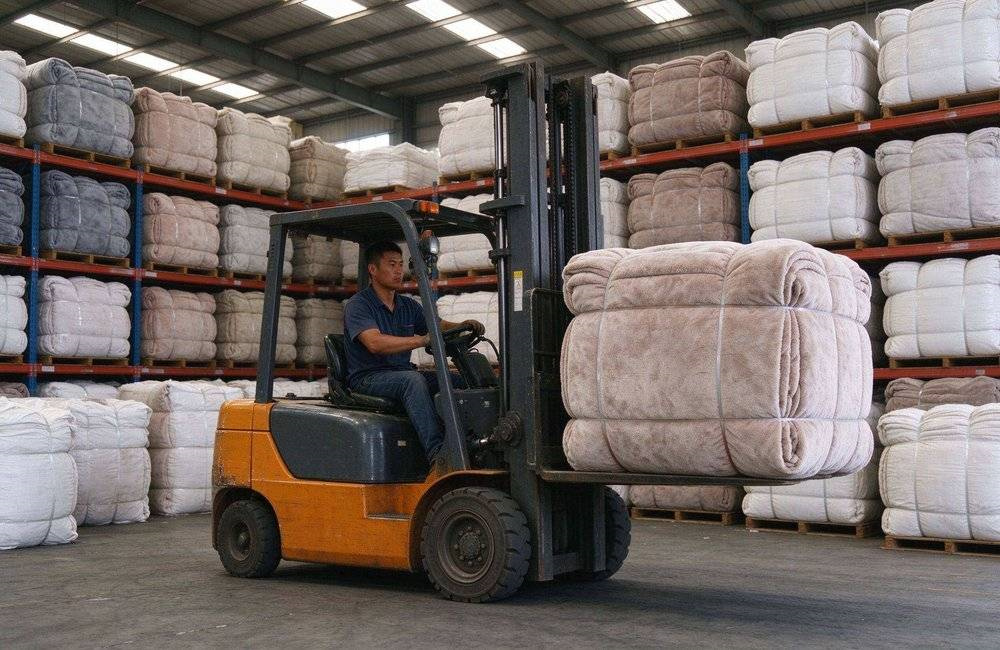
Compressed blanket bales in a relief warehouse.
Blankets are the highest-volume item in most relief orders, and the relief blankets specification is where most programs either save money or create waste. The key variables are fabric type, weight (GSM), size, edge finish and packing density.
Each variable has a direct impact on warmth, durability, freight cost and field usability, and none of them should be decided by default. NOAA preparedness resources can help define the climate profile that drives blanket weight selection. For flood-specific blanket requirements, see our flannel blanket guide for flood relief.
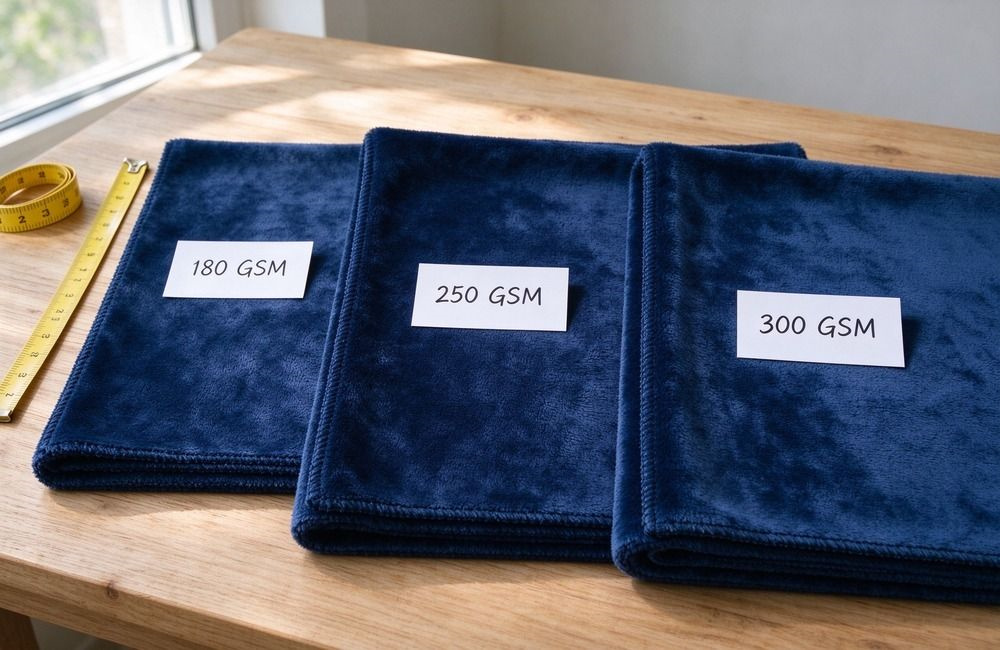
Blanket GSM weights: 180, 250 and 300 GSM.
Flannel blankets in the 180–300 GSM range cover most African relief scenarios. Lighter weights (180–220 GSM) work for flood response and tropical distribution, where quick drying and mould resistance matter more than maximum warmth. Mid weights (250–280 GSM) suit highland and night-shift use, where temperatures drop after sunset. Heavier weights (300+ GSM) are reserved for cold-season and high-altitude programs, and they cost more to ship because they are denser.
Size is the second decision. A standard 150×200 cm blanket covers an adult or a single bed, and it is the most common specification for agency distribution. Smaller sizes (127×152 cm or child cots) are used for nutrition centres and child-focused programs. The size must be written into the specification and verified on the sample, because a two-centimetre difference across 10,000 units changes the total fabric volume and the packing density.

Flannel fabric weave and pile close-up.
Edge finish and colour affect durability and distribution. A double-stitched hem prevents fraying during repeated washing in camp conditions. Solid colours are preferred over prints for institutional orders, because they hide dirt better and do not fade unevenly. The specification should state the colour, the GSM tolerance (usually ±5%), and the test method for colour fastness, so the buyer and factory are measuring the same thing.
For a warmer option without heavier GSM, specify fleece. It traps more air per gram than flannel, delivering more warmth at similar weight, but pills faster and suits low-dust environments best. Choose by field conditions, not by the softest showroom sample.
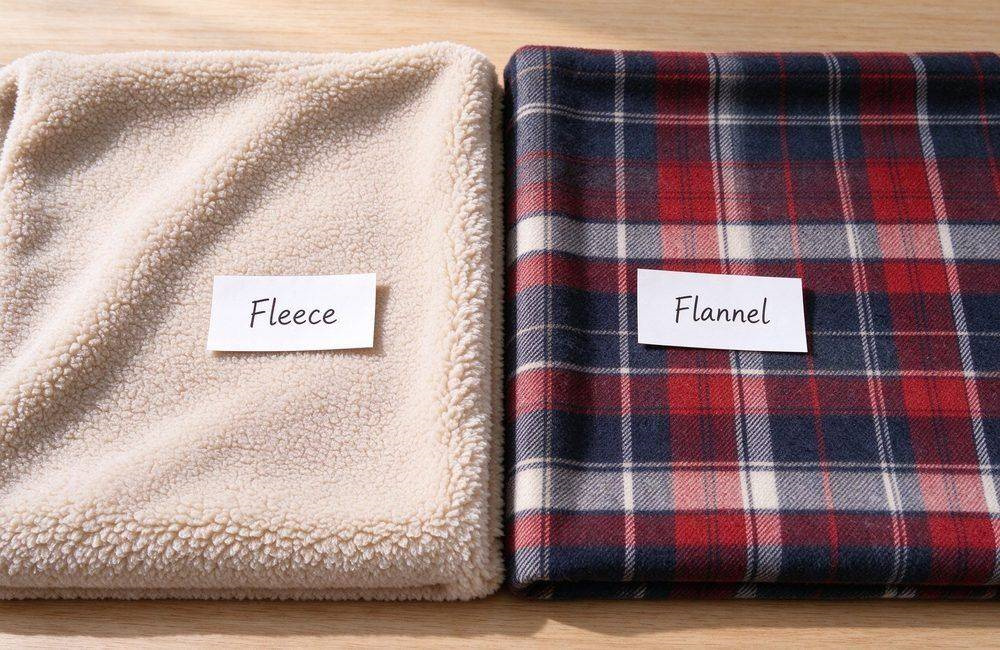
Fleece vs flannel blanket fabric comparison.
This table gives a starting point for blanket selection. The exact GSM should be confirmed against the program's climate data and the field team's input, because a weight that works in one region may be too warm or too cool in another.
|
GSM range |
Typical use |
Warmth & drying speed |
Best for |
|
180–220 GSM |
Flood response, tropical distribution |
Light, fast |
High-humidity zones, quick turnover |
|
250–280 GSM |
Highland, night-shift, general relief |
Medium, moderate |
Most African relief programs |
|
300+ GSM |
Cold season, high altitude, winter response |
High, slow |
Highlands, winter, long-term camps |
|
Fleece 200–250 GSM |
Warmth-per-gram priority |
High, moderate |
Cold but low-dust environments |
The specification should always state the GSM tolerance (usually ±5%) and the test method, so the buyer and factory are measuring the same thing. A blanket that is 10% under weight may still feel acceptable, but it reduces warmth and durability over the program's lifetime.
Relief tents and shelter options form the second major category in a relief order, and they require a different specification logic from blankets. Tents are structural products: the frame, the fabric, the waterproof rating and the anchoring system all determine whether the shelter survives a storm season. A tent that looks adequate in a factory yard can fail in a cyclone corridor if the fabric is too thin or the guy lines are too short.
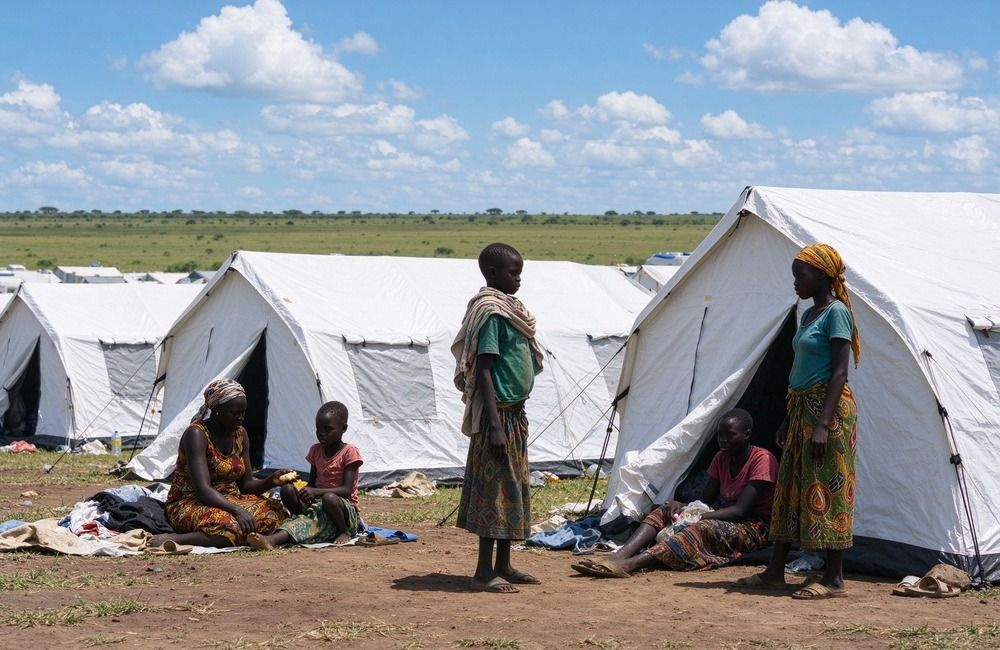
Emergency tents in a displacement camp.
Emergency family tents are the most common specification for displaced households. A typical 3×4 metre tent sleeps four to six people, uses a steel or fibreglass frame, and is covered with a waterproof polyester or polyethylene flysheet. The waterproof rating should be stated in millimetres (typically 1000–3000 mm), and the floor should be a separate, heavier polyethylene sheet that prevents ground moisture from entering.
For programs in cyclone-prone areas, the specification must include wind resistance. This means a stronger frame, additional guy lines, reinforced corner patches and a lower profile. A tent for a stable-climate refugee camp differs from one for the Mozambique channel, and the specification should reflect that. The sample approval stage should include a wind-load check, not just a visual inspection — our cyclone shelter guide covers wind-rated tent specifications in detail.
relief tents shelter options include tarpaulins and shelter kits as an alternative to full tents for rapid response. A standard 4×5 or 4×6 metre tarpaulin can be rigged as an emergency shelter, and it is faster to distribute than a framed tent. Tarpaulins are specified by weight (grams per square metre), weave density and UV stabilisation. For longer-term camps, a combination of tarpaulins for immediate shelter and framed tents for the transition phase is often the most practical plan.
Shelter also includes groundsheets, sleeping mats and nets that integrate with the tent. Ordering tents without matching groundsheets or nets creates a field gap — families use clothing to insulate from the ground. Treat shelter as a system, not a single product.
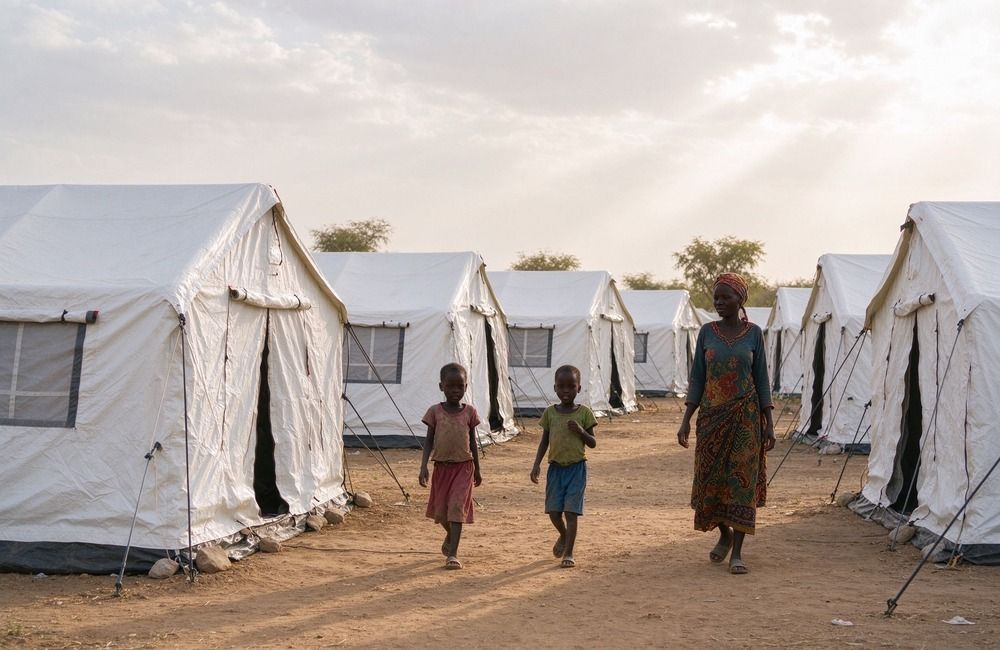
Emergency tents in a displacement camp.
Relief nets and hygiene items are the category most often under-specified in relief orders, because they are seen as consumables rather than protective equipment. In reality, a treated net is a medical intervention: it reduces malaria transmission for the people sleeping under it.
Its effectiveness depends on the insecticide treatment, the mesh density and the physical condition of the net after distribution. WHO health guidance ranks mosquito nets as a core malaria prevention intervention. Our malaria and cholera relief guide covers net specification and WASH kit composition.
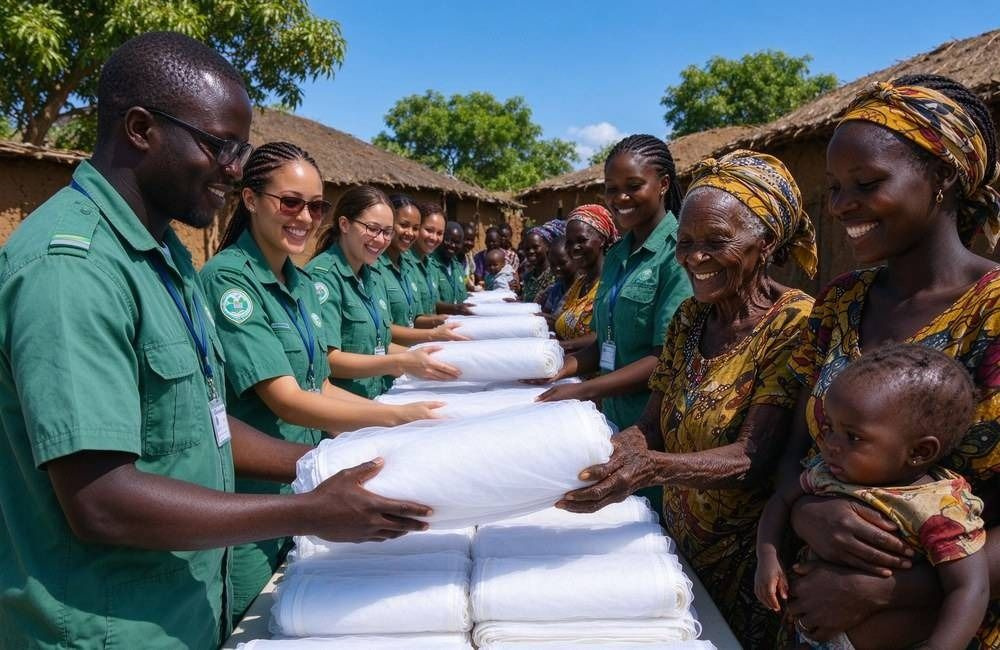
Distributing mosquito nets at a camp point.
Long-lasting insecticidal nets (LLINs) are the standard for malaria-endemic areas. The specification should state the active ingredient (typically pyrethroid), the number of washes the treatment remains effective after (usually 20+), and the mesh size (typically 156 holes per square inch). The net should be rectangular for family use, with a hanging kit included. The packaging must protect the net during transport and include instructions in the local language.
Hygiene kits complement the net program. A standard kit includes soap, a towel, nail clippers, a comb and sometimes menstrual hygiene items for women and girls. Assemble the kit in a sealed bag or carton with contents listed outside, so distribution teams verify completeness without opening every unit. The specification should state the soap weight, the towel size and the bag material, because these are the items most likely to be substituted with cheaper alternatives.
Plan relief nets hygiene items in the same cycle: WASH items such as jerry cans, water purification tablets and menstrual hygiene supplies are often ordered alongside blankets and tents. Plan them in the same cycle — ordering WASH separately means two shipping cycles, two clearances and two distributions instead of one.
Documentation matters most here. LLINs need pesticide registration or WHO recommendation; hygiene items may need safety data sheets. Collect these at the sample stage — missing documentation is the top cause of African port customs delays.
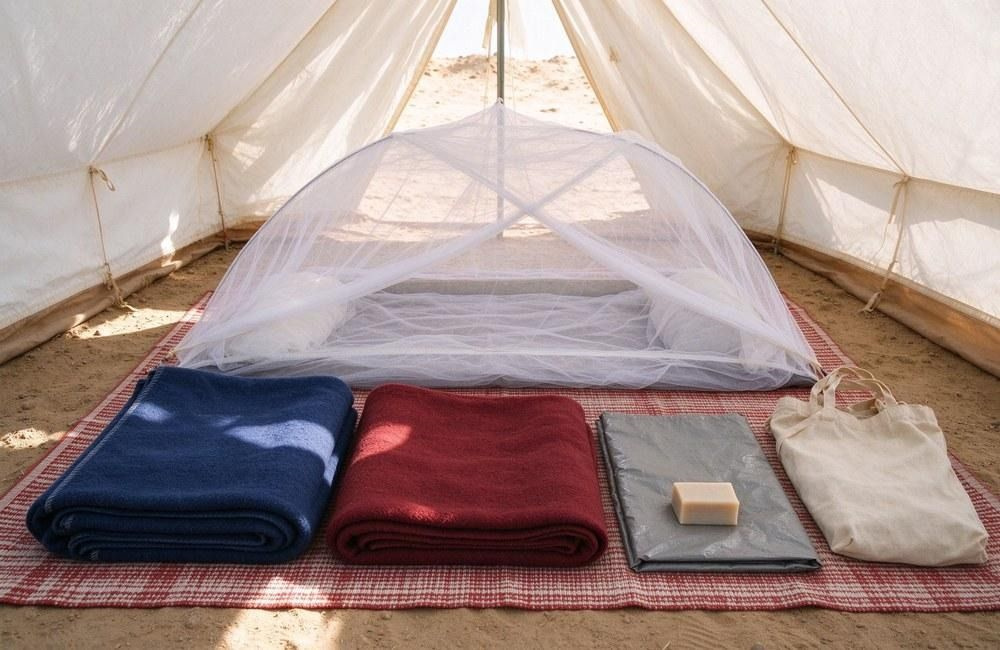
Hygiene kit contents beside a mosquito net.
The relief supply sample approval workflow is the quality gate between a written specification and a bulk order. It exists because a factory can produce a sample that meets the specification and then produce a bulk order that does not — either by mistake, by substituting materials, or by misunderstanding a detail that was not written down. The workflow makes the sample the reference that both sides sign.
The sample approval workflow has five steps. First, the buyer sends the full specification to the factory, including fabric weight, size, colour, stitching, packing and labelling. Second, the factory produces a pre-production sample and sends it to the buyer with a sample report listing actual measurements and test results.
Third, the buyer inspects the sample against the specification, measuring weight, size and stitching, and checking colour fastness if a test is available. Fourth, the buyer either approves the sample or requests changes, and the factory produces a revised sample if needed. Fifth, both sides sign the approved sample as the reference for the bulk order.
The sample report is the document that makes this process auditable. It should list the specification value and the actual measured value for every variable: GSM, length, width, hem width, stitch density, colour reference and packing count. If the actual value is outside the tolerance, the sample is not approved, and the factory must re-submit. This prevents the situation where a sample is approved visually but the bulk order arrives with a 10% weight shortfall.
For multi-category orders (blankets, tents, nets, hygiene kits), each category needs its own sample and its own approval. A common shortcut is to approve the blanket sample and assume the factory will apply the same quality standard to the nets — this is a mistake, because nets are often produced by a different workshop or a subcontractor. Every product line must have a signed sample before production begins.
The sample stage also confirms packing. The factory should pack the sample exactly as bulk — bale or carton, label format, unit count — so the buyer verifies packing density against the freight calculation. A loose courier sample gives no evidence.

Inspectors measuring blanket size in the workshop.
The sample approval workflow is the quality gate between a written specification and a bulk order. It exists because a factory can produce a sample that meets the spec and then produce a bulk order that does not — the signed sample prevents this.
Step
Action
Owner / timing
Output
1. Specification
Send full spec to factory (GSM, size, colour, packing)
Buyer / before sample order
Signed specification sheet
2. Pre-production sample
Factory produces sample + sample report
Factory / 7–14 days
Physical sample + report
3. Sample inspection
Buyer measures GSM, size, stitching; checks sample
Buyer / 3–5 days after receipt
Inspection record
4. Approval or revision
Approve signed sample, or request changes
Both / before bulk production
Signed approved sample
5. Bulk reference
Approved sample is the reference for bulk
Both / throughout production
Signed sample on file
For multi-category orders, every product line needs its own sample and its own approval. Approving the blanket sample and assuming the factory will apply the same standard to the nets is a common and costly mistake.

Approved sample checked against its export carton.
relief goods packing ocean freight is where a well-specified order either saves money or creates a logistics problem. The goal is to maximise units per container while protecting goods from moisture, compression and handling damage. The packing plan should be agreed before production, because it affects how the factory folds and stacks goods, and cannot be changed efficiently after the order is made.
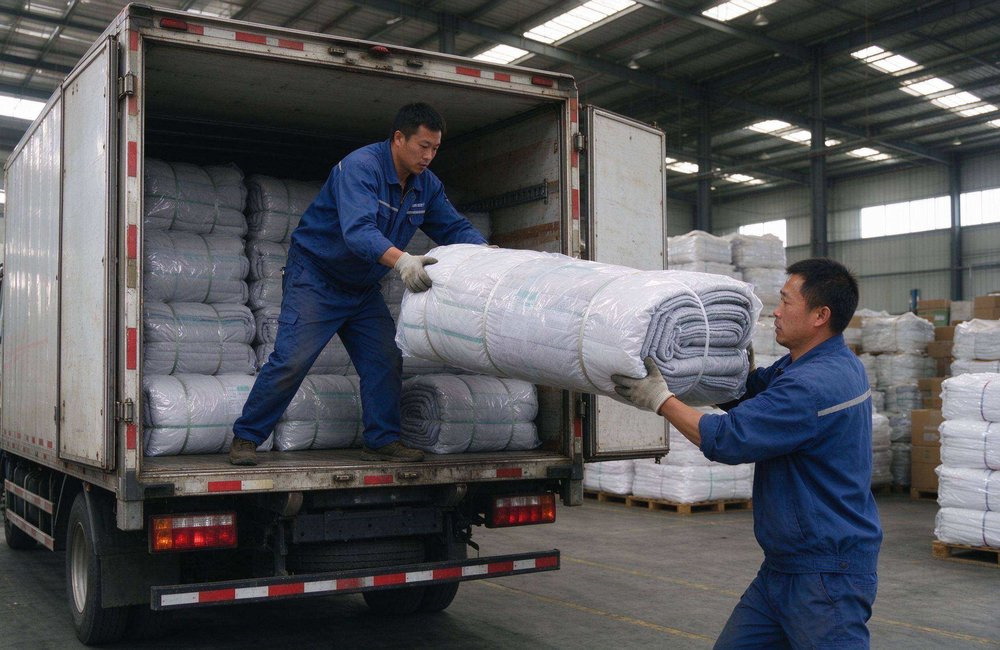
Compressed bales ready for ocean freight.
Blankets are typically packed in compressed bales for ocean freight. A standard bale contains 50 to 100 blankets, compressed to a density that reduces volume by 40–60% compared with loose packing. The bale is wrapped in a waterproof plastic sheet and strapped, with a label showing the product description, quantity, GSM, size and order number. The bale dimensions should be stated in the specification, because they determine how many bales fit on a pallet and in a container.
Cartons are used for products that cannot be compressed or that need individual protection — tents, nets, hygiene kits and responder gear. The carton specification should state the dimensions, the wall thickness (single, double or triple wall), the maximum gross weight and the labelling format. Cartons should be stackable to at least three high without crushing, and they should have handling marks (this side up, fragile, moisture protection) printed in English and the destination language if required.
Moisture protection is critical for ocean freight to African ports. A container crossing the equator experiences wide temperature swings, and condensation can form inside the packaging if the goods are not properly protected. Compressed bales need a waterproof inner liner; cartons need a moisture barrier bag or desiccant packs for hygroscopic products. The packing specification should state the moisture protection method, and the sample stage should verify that it is actually applied.
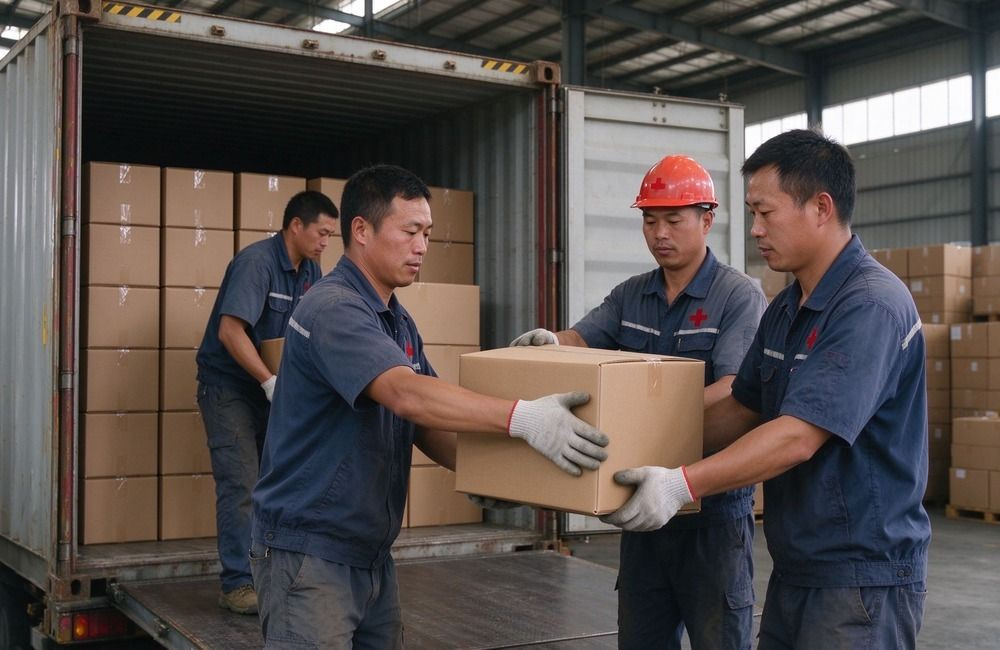
Container loading at the warehouse dock.
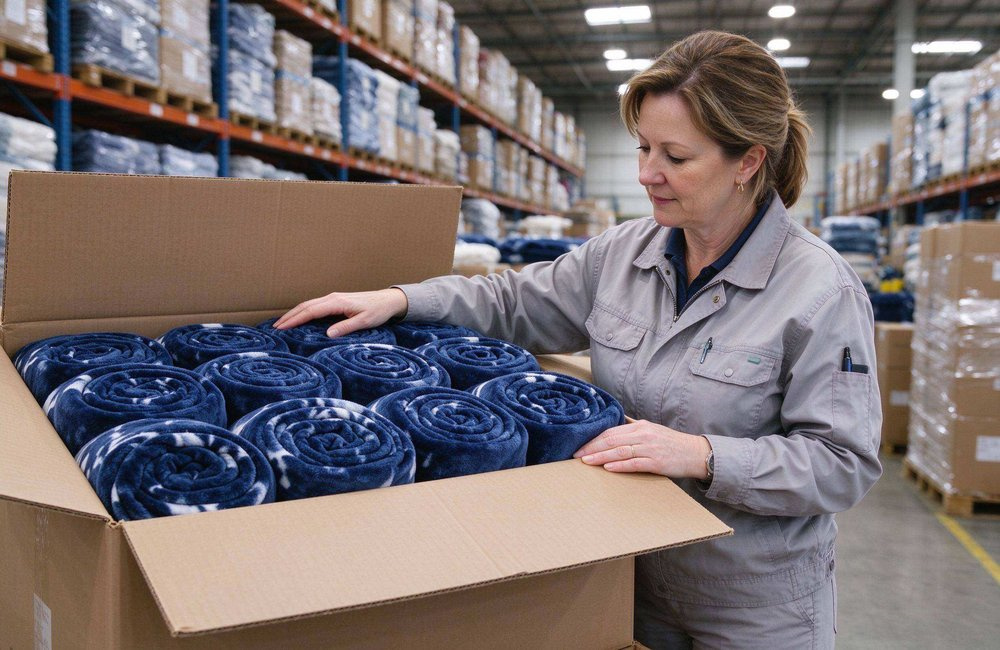
Labelling is the final clearance-speed detail. Every bale or carton shows PO number, product description, quantity, gross and net weight, country of origin and destination port — in English, clearly printed, plastic-sleeved if on a bale. Poor labelling causes customs holds because inspectors must open packages to verify contents.
Delivery inspection of relief goods at a warehouse.
The packing format should be chosen based on the product, the destination port and the distribution method. Compressed bales are the most cost-effective for blankets, but they require a warehouse with bale-breaking equipment at the destination.
Format
Products
Units per package
Protection & container fit
Compressed bale
Blankets, towels, textiles
50–100 units
Waterproof liner + straps; high (40–60% volume reduction)
Export carton
Tents, nets, hygiene kits, gear
5–20 units
Double/triple wall + moisture bag; medium (stackable 3 high)
Palletised cartons
Mixed orders, fragile items
40–60 cartons/pallet
Shrink wrap + corner protectors; medium (easy handling)
Bulk bag (FIBC)
Low-value, non-fragile goods
500–1000 kg
Woven polypropylene; high (rough handling risk)
Every package should show the purchase order number, product description, quantity, gross/net weight and port of destination. Labels should be in English and protected by a plastic sleeve if attached to the outside of a bale.
Pre-positioned relief stock organised by category.
Lead time is the variable that procurement teams get wrong most often, because they calculate it from the order date rather than from the delivery date. A blanket order with a 45-day production lead time sounds manageable, but the program may need the goods on site before the cyclone season starts. Working backwards from the delivery date is the only reliable method.
For emergency supplies lead time Africa planning, expect 30–45 days from sample approval to container loading for a standard blanket order. Tents take 45–60 days because of the frame assembly and waterproof testing. Nets and hygiene kits take 25–40 days. A mixed order (blankets + tents + nets) is paced by the longest item, so the procurement plan should schedule the tent production first and align the other categories to the same loading window.
Seasonal windows add hard deadlines. Indian Ocean cyclones run November–April (peak Jan–Mar); West African floods follow June–September rains; East African long rains fall March–May, short rains Oct–Dec. A plan that ignores these windows either misses the season or pays three to five times more for air freight. Drought and slow-onset disaster programs face different stock rotation challenges.
Factory capacity is another constraint. Pre-season months are the busiest; an October order for December delivery may find the factory full. Pre-positioning — ordering before the season, even before full funding — guarantees capacity at large agencies.
Final delivery is the last underestimated segment. A container at Mombasa or Dar es Salaam still needs 7 to 14 days for clearance, inland transport and distribution. Include this buffer: field delivery by Dec 1 means port arrival by Nov 15 at the latest.
Relief truck departing for field distribution.
The discipline to compare relief supplier quotes separates a professional procurement process from a price-based decision. The lowest quote is not always the cheapest option, because it may exclude packing, labelling, inspection or freight, or it may use a lower specification that the buyer did not intend. A fair comparison for any bulk relief procurement requires a standardised request for quotation (RFQ) that every supplier answers in the same format.
A standard RFQ relief supplies template should list every variable that affects price: product specification (GSM, size, material), quantity, packing format (bale or carton, unit count per package), labelling requirements, inspection terms, delivery terms (FOB, CIF or DAP), payment terms and lead time. Each supplier should quote against the same specification, so the buyer is comparing the same product, not a cheaper substitute.
The comparison should be organised in a table with the same line items for every supplier. The key columns are unit price, packing cost per unit, total product cost, freight cost per unit (if CIF), total landed cost, lead time and payment terms. The total landed cost (product + packing + freight + inspection) is the number that matters, not unit price alone. A supplier with a slightly higher unit price but included packing and inspection can be cheaper overall.
Quality indicators belong in the comparison even though they are not directly priced. These include the factory's certification (ISO 9001, OEKO-TEX if applicable), the sample approval record, the defect rate on previous orders and the factory's capacity to meet the lead time. A low quote with a history of late delivery or weight shortfalls is higher risk; document it in the comparison.
Record the final decision in a supplier evaluation note: why the winner was chosen and why others were not. This creates institutional memory — a supplier rejected for a 10 percent weight shortfall stays on file, so a new procurement officer does not repeat the mistake.

Comparing supplier quotations side by side.
Every supplier should quote against the same specification, so the buyer is comparing the same product. The total landed cost — product + packing + inspection + freight — is the decision number, not the unit price alone.
|
Comparison item |
Why it matters |
Supplier A |
Supplier B |
|
Unit price (FOB) |
Base product cost |
$— |
$— |
|
Packing cost per unit |
Bale/carton + labelling |
$— |
$— |
|
Inspection cost per unit |
PSI or factory inspection |
$— |
$— |
|
Freight cost per unit (if CIF) |
Ocean + insurance |
$— |
$— |
|
Total landed cost per unit |
The number that matters |
$— |
$— |
|
Lead time (days from approval) |
Capacity and reliability |
— |
— |
|
Payment terms |
Cash flow impact |
— |
— |
|
Certification status |
ISO, OEKO-TEX, test reports |
— |
— |
Quality indicators (certification, sample record, defect history) should be documented alongside the price comparison. A supplier with a slightly higher landed cost but a strong delivery record may be the lower-risk choice for an urgent order.

European buyers reviewing blanket and net samples.
relief goods documentation certification is the layer of the procurement process that is invisible until something goes wrong — and then it is the only thing that matters. A container with the right goods but the wrong paperwork can sit at a port for weeks, incurring storage fees and delaying the program. The documentation set should be prepared during production, not after the goods are loaded, because some documents require lead time. The UNHCR supplier hub lists the standard document set for relief goods procurement.
The core export documents in bulk relief procurement are the commercial invoice, the packing list, the bill of lading, the certificate of origin and the insurance certificate. The commercial invoice should match the purchase order exactly in product description, quantity and value.
The packing list should show the number of bales or cartons, the gross and net weight, and the dimensions. The certificate of origin is required by most African customs authorities, and it may need to be legalised by the destination country's embassy or chamber of commerce.
Product-specific certifications depend on the category. Textile products may require an OEKO-TEX certificate or a test report for colour fastness and fibre content. Treated mosquito nets require a pesticide registration or WHO recommendation reference. Tents may require a waterproof test report. Responder gear may require a CE marking or a flame-retardant test certificate. Request these documents at the sample stage, because some certifications take weeks and cannot be produced after shipment.
Inspection documentation is separate. A pre-shipment inspection (PSI) from an independent third party (SGS, Bureau Veritas, Intertek) is required by some African governments and funders. PSI verifies quantity, quality and packing before the container seals, and costs 0.5 to 1 percent of order value — far cheaper than a rejected shipment.
The receiving agency also needs delivery notes, goods-received notes, destination inspection reports and distribution records. Agree the format before shipment — a funder-acceptable document may not suit the field team. A documentation checklist in the RFQ prevents end-of-process gaps.

Inspecting blanket fabric quality in the relief warehouse.
The final step of a bulk relief procurement is to assemble all of the above into a single relief supplies checklist that the procurement team can use for every bulk emergency supplies order. The checklist is a living document — updated after each program — but it keeps a fixed structure so new team members can use it without training. The structure below covers the full cycle and adapts to any product category, including camp-level setup in our temporary shelter guide.
The relief supplies checklist has ten sections. First, hazard and needs assessment: what is the disaster, how many people, what is the climate and what products are needed. Second, specification: write the full specification for every product, including GSM, size, material, stitching, packing and labelling. Third, RFQ: send the same specification to at least three suppliers and collect quotes in a standard format. Fourth, sample approval: order pre-production samples, inspect them against the specification, and sign the approved sample.
Fifth, packing plan: confirm the bale or carton dimensions, the unit count per package, the moisture protection and the labelling format. Sixth, production and inspection: schedule production, arrange a mid-production check if the order is large, and book a pre-shipment inspection. Seventh, documentation: prepare the commercial invoice, packing list, certificate of origin, product certifications and inspection report. Eighth, shipping: confirm the booking, the container loading and the bill of lading.
Ninth, customs: send the full document set to the clearing agent before vessel arrival and track clearance. Tenth, delivery: confirm inland transport, verify goods at the warehouse, record distribution. Each section needs an owner, deadline and status.
Add a lessons-learned section after each bulk relief procurement program: what went well, what was delayed, what specification was missing, which supplier performed. These notes feed the next cycle. A never-updated checklist becomes a formality; an updated one becomes the organisation's most valuable procurement asset.
Buyers reviewing blanket and net samples in the sample room.
This checklist is the master document for every relief order. It should be adapted to the product category and the destination country, but the ten-section structure should remain fixed so that any team member can pick it up and use it.
Section
Key actions
Owner
Status / deadline
1. Needs assessment
Hazard, population, climate, product list
Program team
☐
2. Specification
Full spec for every product (GSM, size, packing)
Procurement
☐
3. RFQ
Send to ≥3 suppliers, collect standard-format quotes
Procurement
☐
4. Sample approval
Pre-production sample, inspection, signed sample
Procurement + QC
☐
5. Packing plan
Bale/carton dimensions, moisture protection
Procurement + factory
☐
6. Production + inspection
Schedule, mid-production check, pre-ship inspection
QC
☐
7. Documentation
Invoice, packing list, COO, certification
Documentation
☐
8. Shipping
Booking, container loading, bill of lading
Logistics
☐
9. Customs clearance
Document set to clearing agent before arrival
Clearing agent
☐
10. Delivery + distribution
Inland transport, warehouse verification
Field team
☐
After each program, add a lessons-learned note: what was delayed, what specification was missing, which supplier performed well. These notes make the checklist more accurate over time and prevent the same mistakes from repeating.

Checking edge stitching and seam density.
A relief procurement checklist covers ten sections: needs assessment, specification, RFQ, sample approval, packing plan, production and inspection, documentation, shipping, customs clearance and delivery. Each section needs an owner, deadline and status. Update it after each program.
Start any bulk relief procurement with hazard and climate. Flood zones need quick-dry, mould-resistant 180 to 220 GSM blankets. Highland and night-shift programs need 250 to 280 GSM. Cold-season and high-altitude programs need 300+ GSM. State GSM tolerance (usually plus or minus 5 percent), size (typically 150 by 200 cm), edge finish and colour.
The main options are emergency family tents (3×4 m, steel or fibreglass frame, waterproof flysheet), tarpaulins and shelter kits (4×5 or 4×6 m, rigged as emergency shelter), and transitional shelters for longer-term camps. Cyclone-prone areas need a wind-resistant specification with a stronger frame, additional guy lines and reinforced corners. The shelter should be treated as a system that includes groundsheets, sleeping mats and nets, not as a single product.
Mosquito nets (typically long-lasting insecticidal nets) and hygiene kits (soap, towel, nail clippers, comb, menstrual hygiene items) should be planned in the same procurement cycle as blankets and tents, not ordered separately. LLINs require a pesticide registration or WHO recommendation reference. Hygiene kits should be sealed with the contents listed on the outside. Ordering everything together reduces shipping cycles, customs clearances and distribution events.
The workflow has five steps: send the full specification to the factory, receive a pre-production sample with a report, inspect it against the spec (GSM, size, stitching), approve or revise, and sign the approved sample as bulk reference. Every product line needs its own sample. Pack it exactly as bulk to verify packing density.

Procurement officer reviewing RFQ documents.
Blankets are typically packed in compressed bales (50–100 units per bale, waterproof liner, straps, label with PO number and quantity). Tents, nets and hygiene kits use export cartons (double or triple wall, moisture barrier, handling marks). Every package needs moisture protection for equatorial ocean crossings. Labels should show the PO number, product description, quantity, gross/net weight and port of destination, in English and protected by a plastic sleeve.
Blankets: 30–45 days from sample approval to loading. Tents: 45–60 days. Nets and hygiene kits: 25–40 days. A mixed order is paced by the longest item. Add 7–14 days for customs clearance and inland transport after port arrival. The plan should work backwards from the field delivery date, not forwards from the order date, and it should account for seasonal windows (cyclone season, rainy seasons) and factory capacity peaks.
Send the same specification to every supplier and collect quotes in a standard format. Compare total landed cost (unit price + packing + inspection + freight), not just the unit price. Include lead time, payment terms and certification status in the comparison. Document quality indicators (previous defect rate, sample approval record) alongside the price. Record the final decision in a supplier evaluation note that explains why the chosen supplier was selected and why the others were not.
Core export documents: commercial invoice, packing list, bill of lading, certificate of origin, insurance certificate. Product-specific: OEKO-TEX or test reports for textiles, pesticide registration for treated nets, waterproof test for tents, CE or flame-retardant for responder gear. Inspection: independent PSI report. Send the full set to the clearing agent before vessel arrival.
Start with the needs assessment: how many people, what hazard, what climate, what duration. Then list the products per person or per household (blankets, nets, hygiene kits, shelter items). Multiply by the population, add a 5–10% buffer for damage and distribution loss, and convert to order quantities by packing unit (bales, cartons). The list should specify every product's full specification, not just the product name.
Textiles: ISO 9001, OEKO-TEX Standard 100, colour-fastness and fibre-content test reports. Treated nets: WHO recommendation or pesticide registration. Tents: waterproof rating test, flame-retardant certification if required. Responder gear: CE marking, high-visibility (EN ISO 20471), flame-retardant (EN 11612) if applicable. Request certifications at the sample stage — some take weeks to issue.
Yes, but it requires careful verification. A supplier who specialises in blankets may subcontract tents and nets to partner factories, and the quality standard may vary across product lines. The buyer should confirm which products the factory produces in-house and which are subcontracted, and require a separate sample and approval for every product line. A single-supplier order simplifies logistics, but it should not come at the cost of quality verification.
MOQs vary: blankets 500 to 1000 per colour and GSM, tents 100 to 500, nets 1000 to 5000, hygiene kits 500 to 2000. Mixed orders can sometimes combine products to lower the overall MOQ, but each line still has a production minimum. Confirm MOQ at RFQ stage.
Yes, most factories can add a woven label, a printed logo or a care label to blankets, tents and bags. The branding artwork should be provided in vector format (AI or EPS), and the buyer should approve a labelled sample before bulk production. For agency-funded programs, the branding requirements (donor logo, program logo, country of origin marking) should be confirmed before production, because relabelling after production is expensive and may damage the product.
Seasonal windows create hard deadlines. The Indian Ocean cyclone season runs November–April (peak January–March). West African floods follow June–September rains. East African long rains are March–May, short rains October–December. A procurement plan that ignores these windows will either miss the season or pay 3–5× more for air freight. The plan should work backwards from the field delivery date, account for factory capacity peaks, and consider pre-positioning orders before the season starts.
Common terms are 30% deposit with the order and 70% against shipping documents (the most common for factory orders), 100% against documents for established suppliers, or letter of credit for large or first-time orders. Some agencies require payment after delivery and inspection, which suppliers may not accept. The payment terms should be agreed in the RFQ stage and included in the purchase order, because they affect the supplier's pricing and willingness to accept the order.
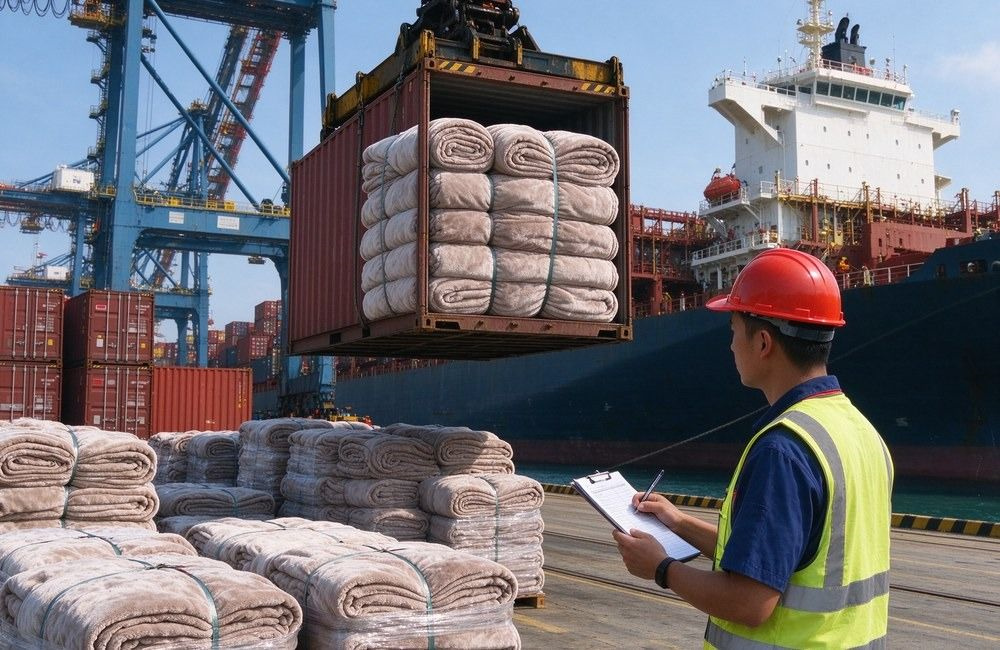
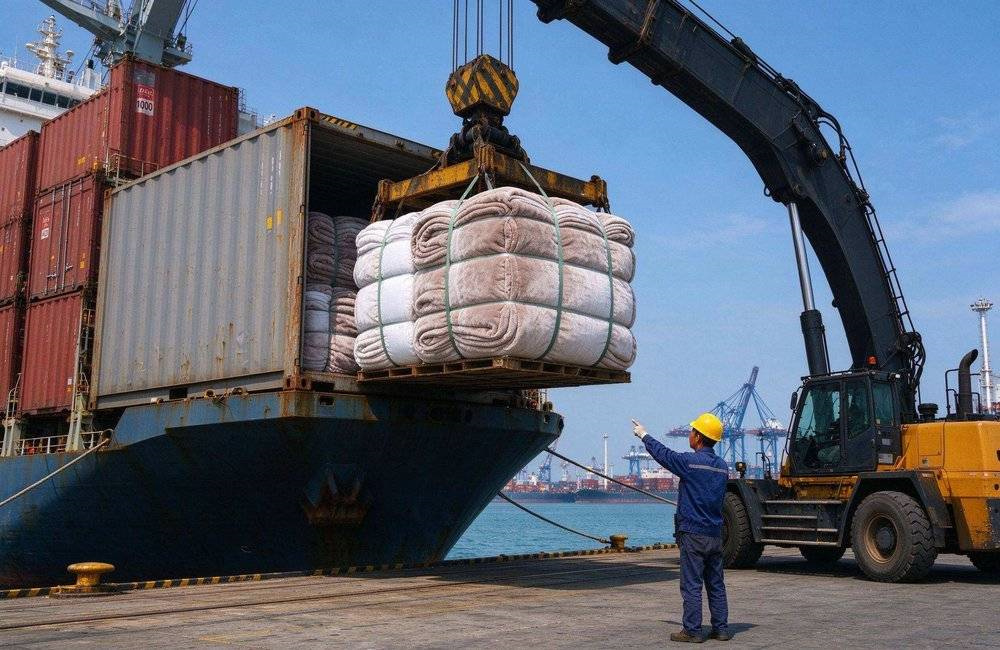
Bulk relief procurement ends at the port, where packing and marking are checked one final time. The tally at the crane is the last verification before the container leaves: quantity on the bill, marks on the cartons, and delivery terms agreed so the order is not stopped at the destination port.
 |

|
روابط ودية :
حقوق النشر © Custom Disaster - Relief Bedding: Tents, Sleeping Bags, Blankets كل الحقوق محفوظة
الفريق المحترف للخدمة !